



Welcome to The Ick, Season 5: TABOO. We’ll be covering death, sex, money—and so much more.
Season 5 will culminate in a print magazine and launch party in San Francisco. Subscribe here so you don’t miss event info and updates. Every paid subscription helps cover printing costs. All online articles are free, see the full season here.
Next up, researcher Katherine Baney reports from the frontier of science.
From test-tube babies to brain implants, she illustrates how radical technologies transition from socially shocking to utterly routine. However, not all scientific breakthroughs move successfully down the pipeline, some get stuck or fail completely. Why?
I’ve been in the thick of the muck of things when it comes to building technologies that make people uncomfortable.
I worked on CRISPR-based gene editing—a tech so controversial there’s a voluntary international moratorium on using it for human germline engineering. Then psychedelics; specifically, engineering yeast to produce psilocybin, mescaline, and 5-MeO DMT.
Now, I work on reversible cryopreservation, a technology with a history so littered with pseudoscience and bad aesthetics that polite society conference attendees avoid eye contact with me the moment I mention it.
Working across these fields taught me a lot about how cutting-edge science is integrated into broader society. I saw a pattern emerge: technology moves from taboo to accepted via cultural containers.
Champions of a given tech create an ecosystem of rules, rituals, social contexts, traditions, stories and institutions1. This ecosystem can hold, transmit, or stabilize a technology, transforming how it is understood, adopted, and used.
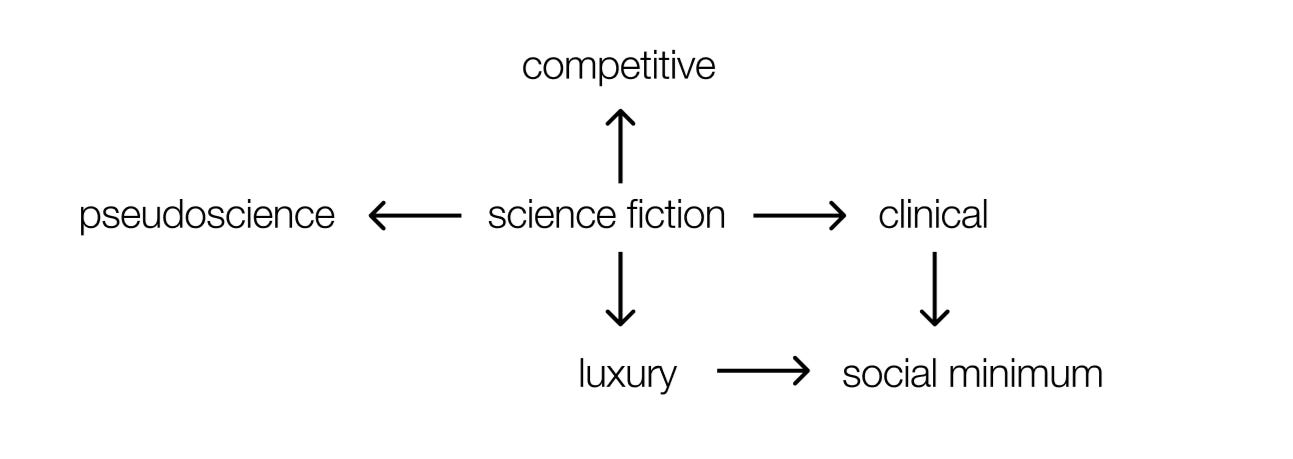

Here, I propose four cultural containers that carry technologies out of the fringe into social normalcy: the clinical container, the luxury container, the social minima container, and the competitive container.
I’m adapting this term “cultural container” from the psychonauts2. When I worked on the form of molecular production for various psychedelics, my mind continuously wandered towards the social form. Was a basement rave just as suitable a setting for psychedelic use as a therapist’s office? Or a smoke-filled hut? Or a crowded music festival, or a walk in the woods? Each scenario applies the same technology — a given psychedelic — with vastly different outcomes due to setting, intention, and story.
When psychedelics were first introduced to the US, western scientists didn’t have an understanding of how much the context of a trip influenced the experience. Researchers would seat subjects on a wax paper-protected geri-chair, in a tiny fluorescently-lit hospital room and interrogate them with clipboard and pen in hand as subjects were rocket-launched into an altered state of consciousness for eight hours.
It was analytical and detached. Subjects had awful trips. Needless to say, the therapeutic potential of the molecules evaded researchers for quite some time.
Today, the state-of-the-art cultural container for therapeutic psychedelic use in the US is a softly lit room covered in plants and textiles, a cozy couch, two calm, licensed therapists, many therapy sessions prior to the trip, and many follow-up therapy sessions. Much of a guide or therapist’s job is to curate a cozy, relaxed physical environment and an open, brave headspace for the patient to occupy as they enter an extremely vulnerable state.
The religious and recreational containers for psychedelics existed for a long time, but Michael Pollan, alongside researchers like Robin Carhart-Harris, Rick Doblin, and Roland Griffiths helped build a completely new cultural container for psychedelics in the 21st century: the clinical container.
Marking the divides between these containers affects how a technology is used and by whom.
After the rise of the clinical container in the second psychedelic renaissance, Denver, Oakland, Santa Cruz, San Francisco, Berkeley, Detroit, Somerville, Cambridge, Seattle, Port Townsend, Olympia, and Tacoma all passed decriminalization resolutions. Oregon and Colorado have (to varying extents) legalized and decriminalized psychedelics. The FDA granted psilocybin “breakthrough therapy” status for depression; by the early 2020s there were over 100 clinical trials for psilocybin underway (1)(2)(3). Pollan helped launch the UC Berkeley Center for the Science of Psychedelics (BCSP) and other universities followed suit, launching dedicated psychedelic research centers. In October 2021, the NIH made its first substantial grant for a psychedelic drug trial in more than fifty years, funding a Johns Hopkins study on psilocybin-assisted therapy for tobacco addiction (4).
Explicitly characterizing the clinical container allowed the field to grow in legitimacy, and for policy to change. Legality, distribution, user population, and accessibility all grew.
Clinical Container: make it medical
The clinical container takes the story “technologists are playing God” and transmutes that story into “we are helping people in need”. This is how psychedelics and cannabis became normalized. It has also delivered us anesthesia, in vitro fertilization (IVF), blood transfusions, hormonal contraception, glucagon-like peptide-1 receptor agonists (GLP-1s), and it is now the thesis for genetic enhancement, brain computer interfaces (BCI), and reversible cryopreservation, to name a few.
In vitro fertilization (IVF)
What was set to be the first planned IVF birth in 1973 was stopped; a colleague interrupted the leading physician in fear the procedure would threaten grant funding. Then, in the aftermath of Roe v. Wade, Congress prohibited federal funding for human embryo research. IVF, in the United States, was pushed into privately funded ventures. Five years later, Louise Brown, the world’s first IVF baby, was born in the UK. The technology was widely framed as the “test-tube baby,” inviting debates about the personhood of embryos, surrogacy, and the prospect of designer babies.
When the sensationalism wore off, IVF settled into its clinical container. But the pivotal moment arrived in 1992, when the Fertility Clinic Success Rate and Certification Act passed. This required fertility clinics to report standardized outcome data to the CDC; its aim was to protect patients from misleading success claims. Here, IVF became a measured, regulated medical technology, supervised by federal institutions. It went from an experimental risky procedure performed by a few nonconformist doctors to ordinary medicine. Now, more than 100,000 babies are born via IVF each year in the United States alone. The “test-tube baby” narrative entirely disappeared; IVF became normalized and loved.
This is a common pattern in the construction of a cultural container. Metrics lead to rules, laws, and practices, and the data provides justification for institutes to regulate the tech.
Brain–computer interfaces (BCI)
Let’s look at less mature technology: BCI. Specifically, the story of first mover Neuralink.
When Neuralink was founded in 2017, its mission was explicit: “develop ultra-high bandwidth brain-machine interfaces to connect humans and computers.” The ambition was never to stop at treating disease, but to build a technology that healthy people might one day choose to use.
Such a future means every user will need brain surgery, which most people hope to avoid unless the alternative is death. For someone with quadriplegia, however, the calculation is different. An experimental brain implant may offer the possibility of regaining communication, independence, or control.
Neuralink now emphasizes their success in restoring function in people with severe neurological disorders and spinal cord injuries. Their website is stacked with patients they have helped: Noland, who suffered a severe spinal cord injury, is now back at school, pursuing a degree in neuroscience. Audrey was left paralyzed from the neck down in a car accident, now, 20 years later, she is the first woman to receive a Neuralink implant, discovered a passion for abstract art, and is now planning to open her own gallery.
Cultural containers often grow by gradually broadening the definition of who should benefit from the tech. If Neuralink proves successful in restoring function for people with quadriplegia and ALS, it is easy to imagine the clinical container eventually widening to include patients with stroke, Parkinson’s disease, treatment-resistant depression, and other neurological disorders as a prelude to BCI becoming an elective consumer technology.
When (implant-based) BCI does become an elective tech, it will likely be in the luxury container.
Luxury Container: make it sexy
The luxury container flips people’s attitudes from indifference or skepticism to desire. It tells a story that makes having or using the technology elite—sexy, even.
Remember the electric vehicles of the early 2000s? They were dinky little bubble cars—cute, but not coveted. Their cultural container held them in either a Jetsons-coded universe or a virtue signaling, environmental-evangelist-sacrifice. It wasn’t until EVs were held in the luxury container that they really took off.
The Tesla Roadster, a sexy, two-seater sports car with a body derived from the iconic Lotus Elise, debuted in 2008; about 2,400 units were sold at ~$109,000. It proved that an electric vehicle could be fast, beautiful, and desirable, rather than a compromise.
The Model S followed in 2012 at a lower price, it won Motor Trend of the Year and outsold many incumbent luxury sedans. Finally in 2017, the Model 3 reached the broader consumer market and a Cambrian explosion of luxury EVs by other manufacturers took off in the early 2020s.
Where the clinical container is largely held together by metrics, definitions, and institutions, the luxury container is almost entirely story and aesthetics. This isn’t to suggest that story alone created the electric vehicle revolution. Falling battery costs, expanding charging infrastructure, government subsidies, emissions regulations, and President Biden’s 2021 executive order all made widespread adoption possible. But these changes alone cannot explain why consumers wanted electric vehicles. The luxury container changed the emotional meaning of the technology. Electric cars became symbols of performance, taste, and modernity rather than an environmentalist’s virtue signal.
You’re already familiar with the luxury container, you’ve seen it in keeping up with the Joneses, the entire market niche of the social media influencer, sponsored athletes, and celebrity ad campaigns—these all use a hero to sell a product. But it is particularly surprising when it comes to overcoming strong social ick or taboo.
The luxury container has carried technologies as varied as EVs, AirPods, LASIK, Oura Rings, whole-body MRI screening, and Impossible’s genetically modified plant-based meat. It will probably bring us commercial space flight, BCI, home robotics, and personal AI devices. And perhaps these technologies will trickle down and become widely accessible, or even expected.
Social Minima Container: make it mandatory
In Neal Stephenson’s book, The Diamond Age, there’s a technology called a matter compiler. It’s essentially a 3D printer capable of creating any basic necessity. It’s standard in every person’s house, like a microwave or fridge. There are bigger and fancier and more capable matter compilers, but the simple ones are considered a basic essential in Stephenson’s world. They exist in what I call the social minimum container.
Technologies in this container are not necessarily seen as basic human rights, but they are expected. The social minima container makes denying access to the tech neglectful, taboo.
Think: toilets, air conditioning, heating, smoke detectors, the internet, contraception, vaccines, even cell phones. These are basically invisible and assumed, with such richly integrated cultural containers we don’t even notice them.
Just before becoming invisible, the technology starts to show robust positive outcomes. From these metrics, institutions have justification for regulating the tech. The tight containment then makes the technology very safe and reliable, which exposes the massive benefit of accessing it, which then exposes inequalities of access and drives demand. So much so that insurance will start covering it, building codes require it, and schools, employers, or landlords provide it.
IVF is actually beginning to move from the clinical container into the social minima container as insurance companies begin to cover IVF services even for people who don’t have infertility issues. The internet speed ran its ascent into the social minima container during COVID, when children couldn’t attend online classes without it.
Some technologies become political battlegrounds as competing groups push them toward social minima or back toward taboo. Take gender-affirming surgery: one camp argues that denying it constitutes neglect, while another considers it heretical. Abortion, contraception, and predictive policing are a few more examples.
The social minima container is where the stakes of cultural containers begin to feel real to me. It’s the line where a technology becomes not just essential to a patient population, or a “treat for those who can afford it,” but rather where society collectively decides that to be human is to have a moral right to this technology.
It’s the stuff of sci-fi to imagine a world where everyone has a moral right to a matter compiler. I think this is also the stuff that motivates many technologists and founders to build. It’s the impulse to make your favorite thing a human right.
Competitive Container: make it a race
On the topic of motivations, the competitive container forms when success becomes symbolic of the competing groups’ prowess. Developing the tech better and faster becomes indicative of the winner’s superior values. The competitive container is transitionary. It can rapidly accelerate the development of a tech and rocket launch adoption, but it is not long lasting.
The Human Genome Project (HGP) was a publicly funded consortium that valued open science and championed a public-good reference genome. Celera Genomics, on the other hand, believed private funding could sequence the human genome faster and more cheaply, while recovering its investment through intellectual property and subscriptions. Each side of the race became a bastion of the opposing values.
The competition itself accelerated the tech development. HGP expected to complete the project by 2005, but when Celera announced their three-year timeline, HGP rallied to go faster. They both jointly announced completion of a draft genome in 2000.
The Space Race was largely for the Soviet Union and the U.S. to demonstrate political, technological, and military superiority, to gain prestige and influence unaligned countries. After all, the technology required to put a man on the moon strongly overlapped with the technology for better missiles.
Sometimes the competitive container is driven by existential fear and the belief that failing to develop the technology first could have catastrophic consequences.
The Manhattan Project is the clearest example. The competition was geopolitical and existential: losing the race was perceived as a threat to civilization itself. The urgency to “win” dramatically accelerated research and concentrated enormous resources into the project.

We are now in the midst of another race. The race to build an artificial super intelligence.
Failure Modes
Cultural containers can fail. This is consequential. They shape capital allocation, research priorities, regulation, the attention of talent, passion, obsession, and ultimately how a technology grows and changes the world.
Sometimes technologies stay inside a science fiction container for too long, with too many failed attempts at realization. Science fiction writers are often the first builders of a cultural container. Long before a technology exists, they imagine the relationships, rituals, institutions, conflicts, and emotions that surround it. They don’t simply describe a tech, but the world in which it feels ordinary.
My current work on reversible cryopreservation is an interesting case study.
In the average person’s mind, cryopreservation exists somewhere between the science fiction and pseudoscience containers: Walt Disney’s frozen head, or 2001: A Space Odyssey. But reversible cryopreservation already exists. It’s a foundational subtechnology to IVF. Since the 1980s, we’ve reliably vitrified and thawed embryos. Tens of thousands of bone marrow transplants are enabled by vitrifying and thawing donations, and cryobiologists have been working to scale the technology to much needed donor organs. Reversible cryopreservation should sit solidly in the clinical container.
The farther cryopreservation moves from cells and tissues toward the whole body, the more its cultural container changes. Preserving an embryo is medicine; preserving an organ is medicine; preserving a person immediately evokes associations with immortality. It actually moves into a fictional luxury container — the field has been littered with headlines like “Rich People Are Freezing Themselves,” “Decapitate Now, Immortality Later.”
But the best realization of cryo is not preserving someone indefinitely. Rather, it is preserving a patient with a terminal illness just long enough to get them access to a cure. Perhaps the technology will one day slip out of the clinical container and into the social minima container.
If technologists promise the fictional world long before they can deliver the underlying technology, folks eventually notice the gap. I believe this is what happened to Google Glass when its creators tried to place it in the luxury container. This is definitely what happened with cryo, room-temperature superconductors and, for a long time, much of the longevity field. Once the principles of the technology begin to sink into pseudoscience it’s a long, difficult climb back out.
There are other fail modes, too. Sometimes a container fails to carry a technology. A useful technology becomes cuffed to a culturally icky story, and gets stuck in a container that limits where it can go, who uses it, who works on it, and how it integrates into a society. Cultural containers can also be too restrictive and bury promising therapeutics or beneficial microbes in far too much regulation.
Sometimes a container fails to contain a dangerous tech: it spreads faster than the rules, institutions, norms, and safeguards needed for it to sanctify humanity. In many cases, the impact is not just a lost augmented reality display like Google Glass, it’s a lost disease prevention like Golden Rice or the HPV vaccine, or an opioid crisis, or a generation growing up with their dopaminergic system tethered to an algorithm.
Building Cultural Containers on Purpose
But we are getting better at building cultural containers.
When the tech tree grew its great bough for cars in the early 20th century, tens of thousands of Americans died within the first decade of mass automobile rollout. When that great branch extended towards autonomous vehicles, the cultural container grew with it, applying all the lessons of past automobile tech development. After hundreds of millions of fully driverless miles, autonomous vehicles are proving to be safer than human-driven cars.
When scientists realized the potentially catastrophic effect that recombinant DNA (rDNA) could wreak, they came together for a voluntary moratorium on the technology until they could devise acceptably safe experiments, practices, and regulations.
Similarly, scientists called for a moratorium on human germline engineering after the invention of CRISPR gene editing technology. Society opted to develop the tech more slowly than our technical capabilities actually permitted. Even so, there are 136 active CRISPR-based therapeutic clinical trials worldwide; this step in the clinical container will lay the foundations for future applications, maybe even germline edits.
Both of these containers, for rDNA and CRISPR gene editing, were built on premonition, not reaction.
And perhaps the greatest example of a container built on premonition is that of the current race towards artificial super intelligence. I can’t think of a single other technology that has such an intensely built out container, hundreds of millions in funding for AI safety, organizations built to measure the pace, progress, and harm caused by AI, even frontier lab leaders publicly calling for external evaluations.
For most of technological history, we built the container after the technology arrived. We crashed cars before we invented traffic laws. We discovered problems, then told stories which informed rules and metrics, which justified institutions and practices needed to contain and carry the tech. Sure, everything is clearer in hindsight, but we can see this pattern and apply it.
As stranger and more powerful technologies enter the world, building the technology itself is only half the work. The other half is building the world around it: the institutions that govern it, the metrics that make its effects legible, the stories that give it meaning, the rituals and practices that determine how people use it.
This can’t be done by technologists alone. Users, writers, journalists, artists, policymakers, neighborhoods, funders, scientists, engineers, and designers all contribute to the social infrastructure that forms a technology’s cultural container.
If there is a technology you wish to see flourish, fail, or change course, consider how you might shape its cultural container.
Katherine Baney is a researcher, scientist, and writer. Read more of her writing on Substack or her website.
Thank you for reading The Ick, Season 5: TABOO.
Season 5 will culminate in a print magazine and live reading in San Francisco. All online articles are free, but please consider these paid subscription tiers. All proceeds go toward printing costs.
In her book, Antimemetics: Why Some Ideas Resist Spreading, Nadia Asparouhova describes “champions” as “firestarters … they help ideas catch on, and, in some cases, create the conditions for unlikely ideas to take off.”
Pollan defines a "cultural container" as the set of rules, rituals, social contexts, and traditions that surround and shape a human experience in regards to psychedelics.
